
November 2024
Core skills: Data mining, Machine Learning, Classification, Cross-validation.
Opinion spam, characterized by the presence of fake reviews designed to deceive readers, has become an issue with the rise of online platforms like TripAdvisor and Yelp, which have been increasingly used by businesses to influence customer perception. This project specifically targets the classification of negative reviews, as these reviews often carry notable weight in consumer decision-making and have been shown to impact brand reputations considerably when left unchecked [8; 9]. Our analysis uses several machine learning classification models, each executing the same task; spam detection. The employed models can be categorized into linear classifiers: Multinomial Naive Bayes (Generative) and Logistic Regression with Lasso Penalty (Discriminative). On the other hand, we have non-linear classifiers: Classification Trees and Random Forests (Ensemble of classifiers)
The dataset is structured into five folds, meant to facilitate the training and testing of our models. Folds 1 through 4, comprising 640 reviews, are used for training and hyperparameter tuning. Fold 5, containing 160 reviews, is reserved for testing and evaluating the models. For the training phase, cross-validation is utilised to optimise hyperparameters and improve generalisation capabilities. Cross-validation enables the model to learn patterns across different subsets of data, thereby reducing overfitting and providing a more reliable estimate of model performance on new data. The models' hyperparameter were tuned using grid-search.
The data was pre-processed by tokenizing and lemmatizing of the text, removing stopwords, and TF-IDF vectorisation. Taking these measures contributes to a more clean, interpretable and structured input for our models. Irrelevant and redundant information is reduced, while preserving essential linguistic characteristics that point to deceptive and truthful content
Additionally, Cochran's Q test and the McNemar's test were used to test statistical significance of the differences in accuracy between models
Firstly, the accuracy of the generative linear model
(Multinomial Naive Bayes) did not significantly differ from the
discriminative linear model (Logistic Regression with Lasso Penalty),
for neither unigrams nor bigrams. According to our results, the
Logistic regression got an accuracy of 84\% while Naive Bayes model
yielded an accuracy of 83\% (both unigrams). With bigrams, Naive
Bayes outperformed Logistic regression. According to previous findings,
logistic regression has a tendency to achieve higher accuracy in cases
with non-independent features, in for example text classification
\cite{pranckevivcius2017comparison}. Our results did not corroborate this.
A lack of a significant difference may be due to the fact that our dataset
was relatively limited and text data is known for its sparse features,
and may not provide enough variance to highlight differences between the models.
Additionally, regularisation of the Logistic regression may have constrained
the parameters, essentially simplifying the model. Overall, the models all performed
comparibly well.
Next, there was no systematic performance improvement seen from non-linear
classifiers. The random forest with unigrams did perfom marginally better,
though this difference was insignificant.
This slight advantage may be explained by the fact that random forests have
the ability to generalize from complex, non-linear patterns in high-dimensional
data while avoiding overfitting. This contrasts starkly to the classification tree,
which consistently underperformed. The McNemar results confirm that the classification
tree had a significant lower accuracy compared to all other models, for unigram and
bigram models. Decision Trees, despite their ability to also capture non-linear
relationships, may have been fit to noise in the training data rather than the
underlying distribution \cite{song2015decision}.
This notion underscores why the aggregation of multiple trees in the
Random Forest model allowed for a more nuanced representation of
feature importance. Overall, Naive Bayes and Random Forest were the
best performing models across all metrics. Logistic regression performed
moderately well, as the logistic regression with unigrams performed
significantly better than random forests with unigrams.
Below, an overview of the model metrics is shown.
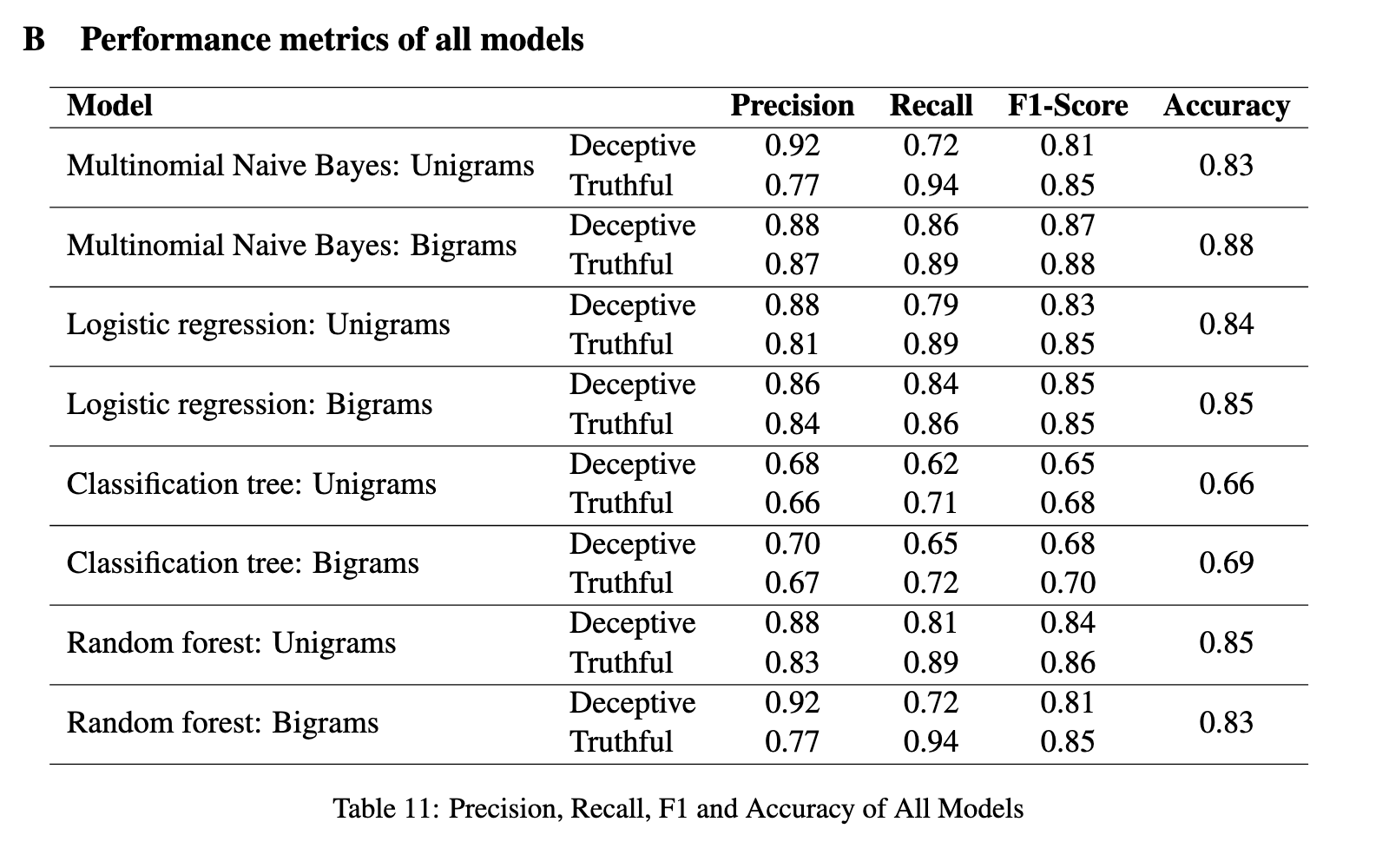
The addition of bigram features generally enhanced performance for models that struggled with word context, such as Naive Bayes and Random Forests. Specifically, the Naive Bayes demonstrated an improved performance with bigram features, altough insignificant. Perhaps, the Naive Bayes model benefits from the additional contextual information pro- vided by bigrams, enabling it to better distinguish between truthful and deceptive language patterns. Only for the random forests the addition of bigrams decreased accuracy. Therefore, the use of bigrams varies depending on the classifier’s inherent strengths in handling contextual information.